Most externally bookable meeting rooms in German coworking spaces are empty most of the year. The operators who have figured out how to fill them are earning meaningfully more per hour on the same rooms than they earn from members.
We ran 12 months of Cobot data to see how big the gap is between the two groups, and what closes it. We also checked the rest of Europe, and the pattern holds there too.
Our co-founder Thilo Utke recently spoke with Jean-Yves Huwart from Coworking Europe to discuss our findings.
Watch their 12-minute conversation, or keep reading for the charts and full data. Or keep reading for the graphs and full data behind the numbers.
How We Analyzed Our Coworking Data
Germany is one of Europe’s largest coworking markets. 61% of the German spaces on Cobot are in cities with populations exceeding 100,000, while 39% are in smaller cities and rural areas. That’s broadly in line with the 2022 BBSR (Bundesinstitut für Bau-, Stadt- und Raumforschung) coworking trend study.
Across Germany's three largest coworking states, the BVCS (Bundesverband Coworking Spaces Deutschland) 2025 industry report saw a 40% / 34% / 26% split for North Rhine-Westphalia, Bavaria, and Baden-Württemberg. Cobot's German spaces split 44% / 31% / 26%. So the regional distribution matches too.
Room utilization is measured against 8 hours a day, 5 days a week. Weekend bookings and resources with unusually long availability are clamped to the same window.
The Supply of External Bookings Is Already Healthy
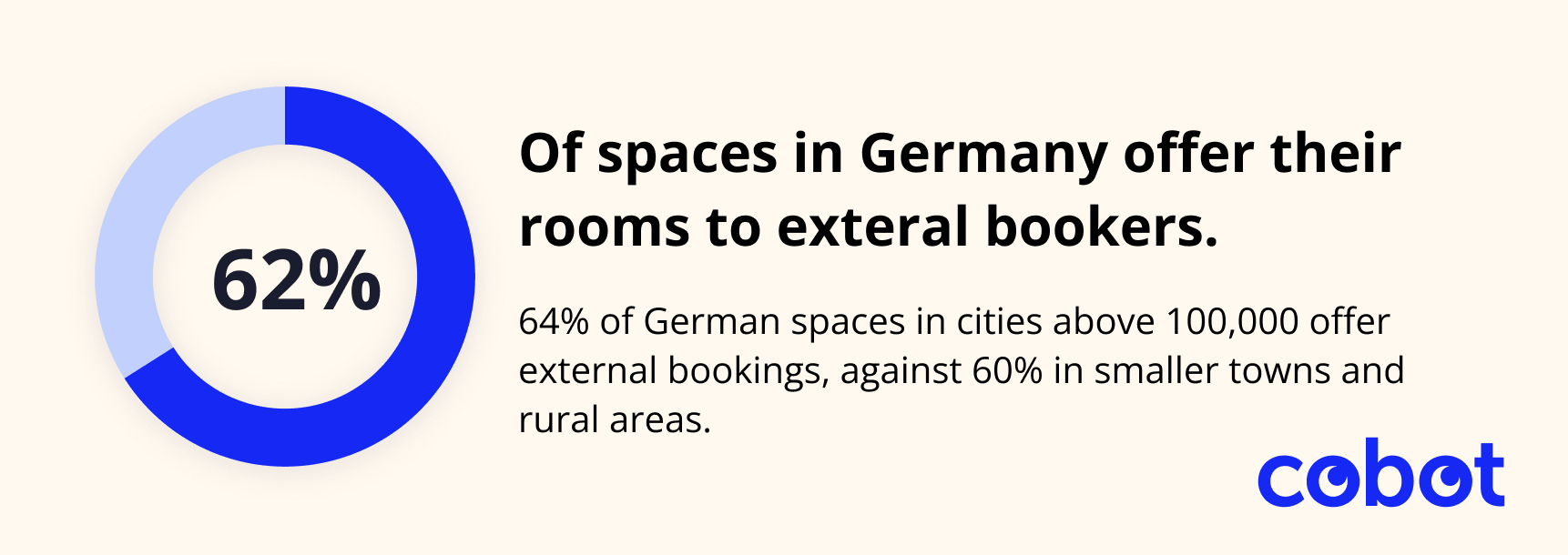
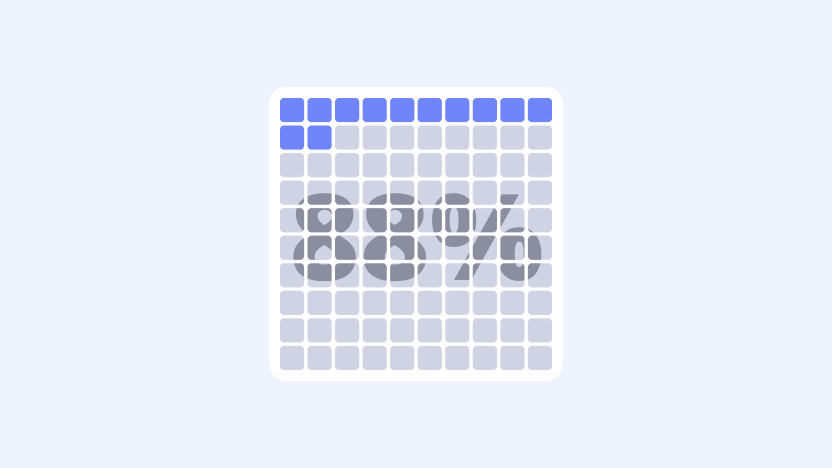
62% of German coworking spaces on Cobot offer external bookings.
The median offering space lists three externally bookable resources. Supply is close to identical inside and outside big cities: 64% in cities over 100k, 60% everywhere else.
And these aren't mostly desks or parking spots.
82% of those resources are rooms. Desks and access passes make up 12%, parking and equipment 6%.
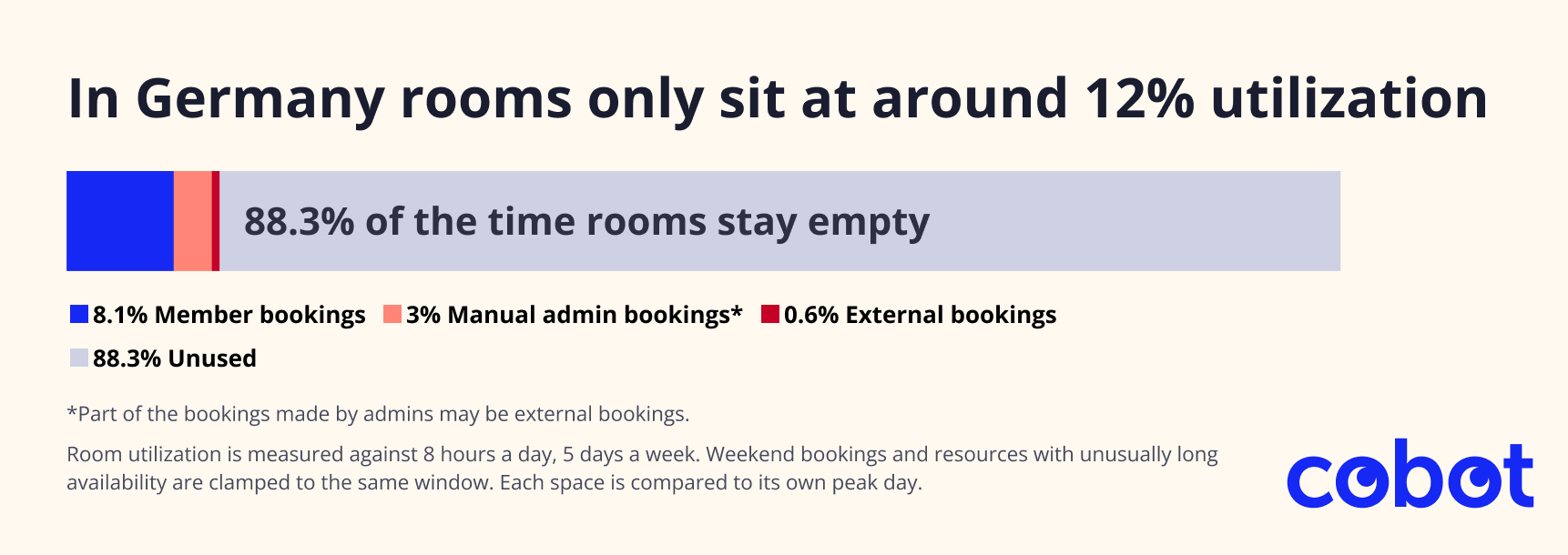
Germany-wide, room utilization runs at 11.7%.
So this is mainly a meeting room story. Which raises the obvious question:
If the rooms are already there, why aren't more people booking them?
Only 0.6% of available room time comes from external bookings, according to our data. Another 3.0% comes from admin bookings, where operators manually enter a booking after receiving a phone call or email.
Even if we assumed every admin booking came from an external inquiry, that would still put the current ceiling for external demand below 4%.
Even in the busiest cities, the busiest day of the year still leaves most of the room capacity unused. Berlin, for example, has an average room utilization of 12.4%, with a peak day of 18.2%. Hamburg reaches 16.5% on average and 38.2% on its busiest day.
And this isn't just because lots of completely unused rooms are dragging the average down.
If we only look at spaces that received at least one booking during the year, utilization rises to 14.9% on average, with a peak of 23.5%.
There is still plenty of room left.
These numbers are not an artifact of dormant inventory. These rooms are being used. Just not very often.
The gap: Same Supply, Wildly Different Demand
The difference becomes clearer when we look at how many external bookings spaces are actually receiving.
In the last three months, 36% of spaces in cities received more than 10 external bookings. Outside larger cities, that number drops to 10%.
Over 12 months, resources in cities received more external bookings on average than those outside larger cities. Overall, 70% of offering German spaces received at least one external booking in the last three months. But only 26% cleared 10.
So most spaces are technically part of the external booking market, but don't seem to be getting much visibility within it.
The rooms are listed. The people looking for them just aren't finding them.
That points to a reach and visibility problem more than an inventory problem.
External Bookings Don't Crowd Out Members
One common reason operators are cautious about external bookings is the fear that outside bookings will take rooms away from members.
The data doesn't show much room utilization to protect in the first place. Member-only room utilization is 8.1% across Germany and 8.9% in cities. Most of the time, these rooms are empty.
And again, even when we remove rooms that were never booked at all, average utilization only reaches 14.9%, with a peak of 23.5%. So the low numbers aren't simply the result of completely dormant inventory.
There is capacity available for more external bookings.
Do Higher Prices Reduce External Bookings?
We split spaces into two groups based on how much they mark up external bookings compared with member prices, then looked at 12 months of activity.
Spaces charging a markup of 1.5× or less had a median of:
- 4 member bookings
- 1 external booking
- 17% of total room bookings coming from externals
Spaces charging more than 1.5× had:
- 62 member bookings
- 6 external bookings
- 9% of total room bookings coming from externals
In spaces with higher markups, visitors make up a smaller share of bookings, but they still book more often in absolute terms. These spaces are simply busier overall. That suggests operators put their most popular rooms behind higher prices, either deliberately or because those are the rooms they value most for members.
Spaces marking up above 1.5× also earn more per external booking. For rooms in high demand, pricing is a real revenue lever.
Looking at Germany overall, 57% of spaces charge visitors the same rate as members. 38% charge more, and 4% charge less, half of which let members book for free through membership credits.
There’s another interesting pattern in the data.
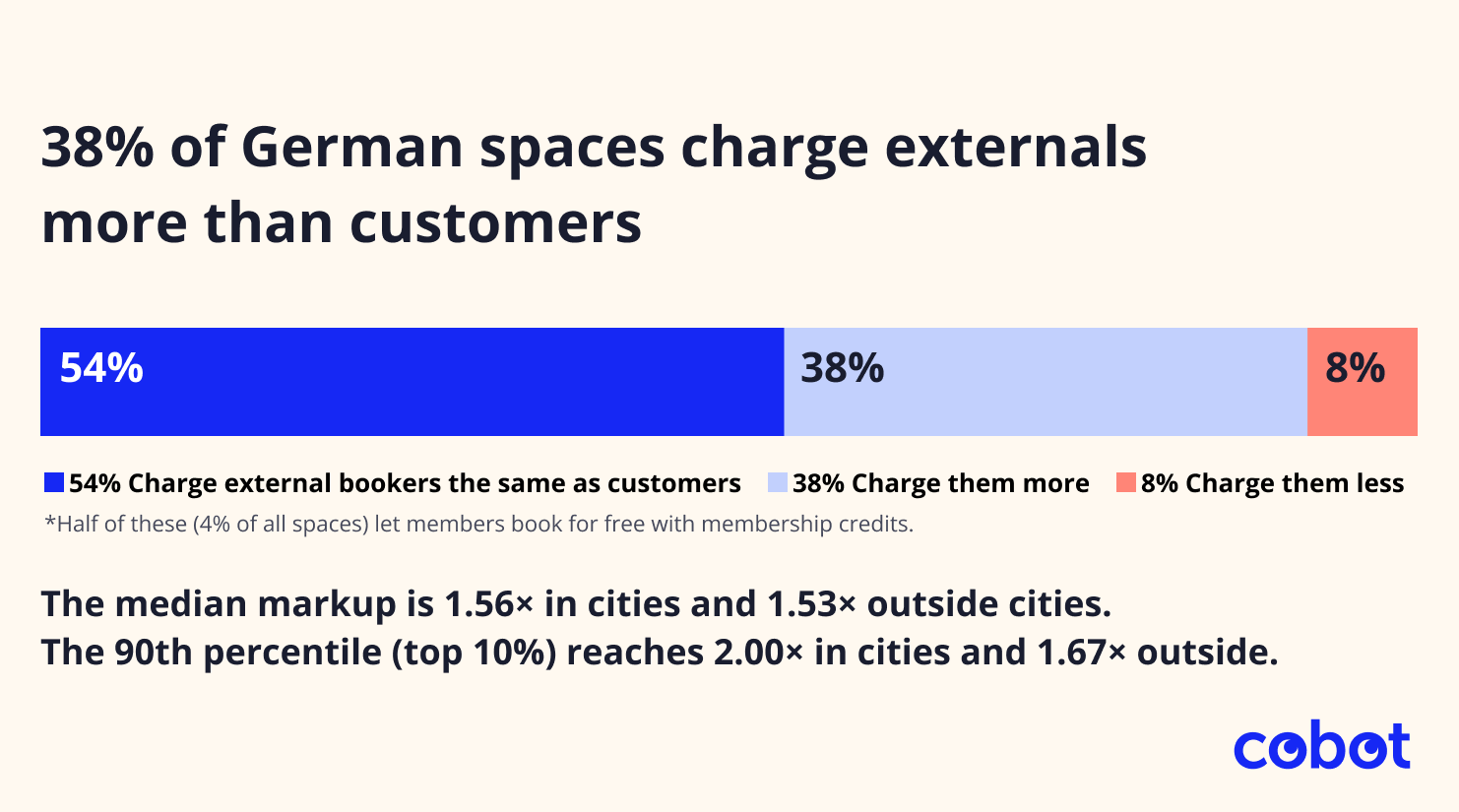
Looking at Germany overall, 56% of spaces charge external customers the same rate as members. 38% charge more, and 8% charge less, half of which let members book for free through membership credits.
Where operators do mark up their rooms, the median is 1.56× in cities and 1.53× outside cities. The 90th percentile (top 10%) reaches 2.00× in cities and 1.67× outside.
And the difference in price can be substantial.
| City | Median Member €/h | Median External €/h | Median Markup | Share charging more |
|---|---|---|---|---|
| Karlsruhe | 29.00 | 47.88 | 2.23× | 72% |
| Berlin | 32.00 | 49.00 | 1.76× | 54% |
| Dresden | 32.50 | 35.00 | 1.43× | 61% |
Note: Markup is the median of each space's own markup, not the ratio of the two price columns. That's why it doesn't equal Median External ÷ Median Member.
Karlsruhe operators earn a median € 18.88 more per external hour than they earn per member hour, on the same rooms. In Berlin, € 17 more.
External Bookings in Europe: How Germany Compares
Note: Every figure in this article comes from real spaces. In Germany, our coverage is broad enough to represent the market. For other countries, treat the numbers as a well-grounded snapshot rather than a national average.
Looking outside Germany, the offer is smaller, and the pricing discipline is weaker. Only 38% of coworking spaces in the rest of Europe offer external bookings, compared with 62% in Germany.
And while 26% of German spaces received more than 10 external bookings in a quarter, that figure is 14% in the rest of Europe.
| Germany | Rest of Europe | |
|---|---|---|
| Spaces offering external bookings | 62% | 38% |
| Receiving > 10 bookings in a quarter | 26% | 14% |
| Median external resources per offering space | 3 | 3 |
| Share of external resources that are rooms | 82% | 73% |
| Share of spaces that mark up rooms above member rate | 38% | 20% |
| Median room markup where applied | 1.56× | 1.50× |
The broader pattern is similar across Europe: rooms make up 79% of externally bookable resources. That's the shape of a market treating external bookings as a proper product, and it points to where the ceiling is for operators everywhere else.
Four Ways to Grow External Bookings
The rooms exist. The offer exists. What is missing is how they get in front of people who want to book them.
- Sell the room like a product. A listing needs more than a room name and an hourly price. Show photos. Explain what the room is like. List the equipment. Mention things like projectors, catering, or other extras. If the listing feels like a spreadsheet row, it's probably not going to do much to convince someone to book it.
- Be findable where external bookers actually look. A landing page on your own website is useful for people who already know your space exists. But external bookers don't always know where they want to book yet. They might be searching for a meeting room in their city, comparing different spaces, or looking for a place that fits a specific need. Make sure your rooms can show up in those searches too. List them on Google Business Profile, meeting room platforms, and other places where people look for spaces. The easier it is for someone to discover a room, see what's available, and understand what they're getting, the more likely they are to book it.
- Flip the process. A phone-first booking process puts a limit on how many bookings a small team can handle. The 3.0% of admin bookings in the data is a useful reminder that some bookings still need to be handled manually. That can include blockers, events, internal bookings, or other operational needs, but it can also mean a customer is relying on someone from the team to make a booking for them. For a small team, the more straightforward bookings that can happen without staff involvement, the less time gets spent on routine admin. And when someone wants to book a room at 10 pm on a Tuesday, they don't have to wait until Wednesday morning for someone to reply. The easier it is to book, the less likely that customer is to look somewhere else.
- Price with intent, not fear. A markup isn't necessarily a bad thing. If a room is in demand, charging external customers more can be a straightforward way to increase revenue. But the data also shows that many spaces aren't using external pricing at all, while others may be pricing popular rooms high enough to limit the number of external bookings they receive. The right approach depends on what you want the room to do: generate more bookings, generate more revenue per booking, or balance external demand with member access.
Ready to Fill Your Meeting Rooms?
External bookings are the product area Cobot is building for this quarter, and this data is the reason.

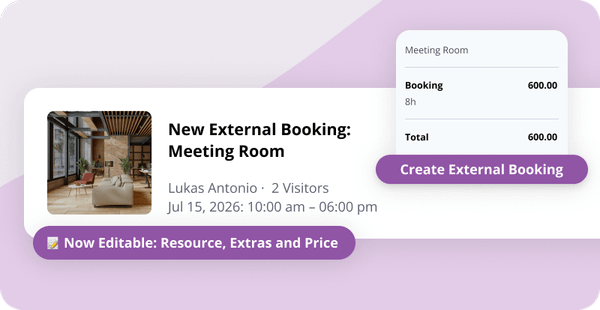
Cobot's External Bookings feature gives visitors a public checkout with instant payment, booking extras, and email confirmations. Try it free for 30 days, no credit card or commitments needed, or book a demo to see how it fits your space.