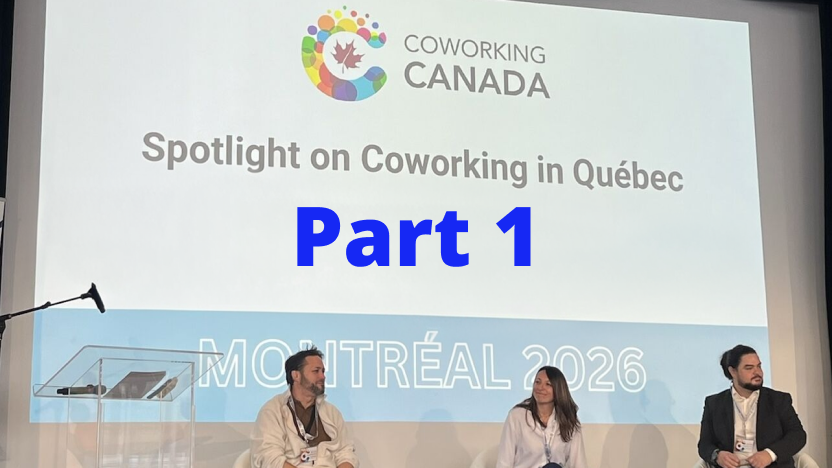
The 12th annual Coworking Canada Unconference took place October 19 to 21, 2026, at the Montréal Science Centre and Montréal CoWork 🇨🇦. This year’s theme was Shared Futures: Building Stronger Communities Together, and the room reflected it from the first minute. Our CEO Thilo Utke was there for all three days.
Ashley Proctor, Executive Director of Coworking Canada, opened by acknowledging the Indigenous land the event was being held on and by honoring Shane Pointe (Te’ta-in), Musqueam Elder, and Amanda Kennedy, Haudenosaunee advocate and educator, both of whom passed in recent years. Both contributed to past editions of the Unconference. Shane led the opening ceremony at the 2024 event in Vancouver, which we recapped on the Cobot blog.
Spotlight on Québec: three operators, three generations
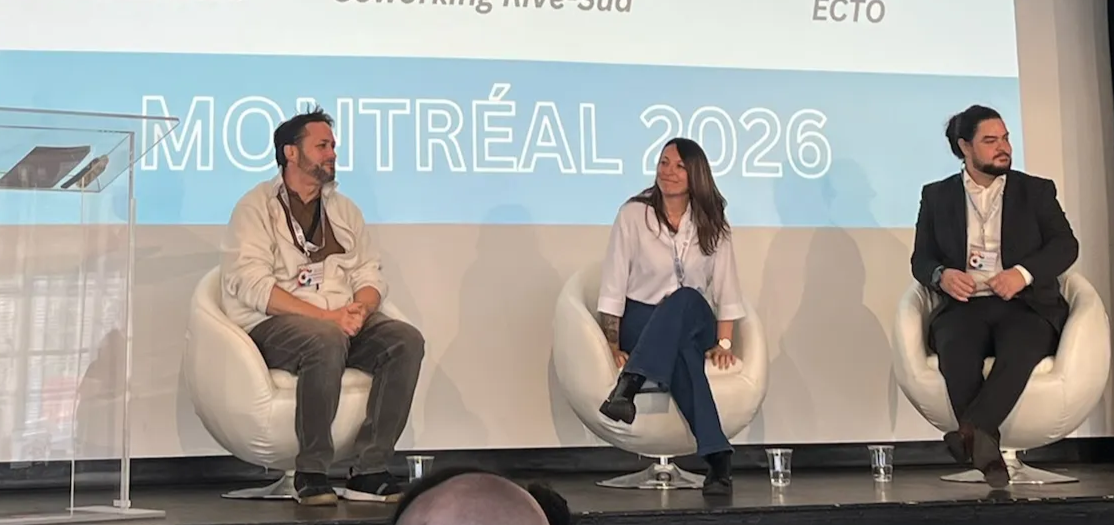
The first local panel brought together François Richard (ECTO), Francis Talbot (Montréal CoWork), and Aurélie Pepin (Walter Montréal), each representing a different generation of Québec coworking.
François represented ECTO, the oldest coworking space in Montréal, founded in 2009 out of a social movement and an IT community that wanted a place of its own. ECTO was the only space on the panel with no private offices, a choice that reflects its roots. Post-pandemic, François said, some people have a harder time feeling comfortable around others again. ECTO is now not only its own community, it is also a home for other communities that gather there.
Francis came to coworking through his family’s real estate business. He runs Montréal CoWork, which opened in 2016. After the pandemic, his clients diversified across every industry, and fewer of them arrived knowing exactly what they wanted. Montréal CoWork responded by diversifying the kinds of spaces inside the location so people could find their fit after walking in.
Aurélie spoke for Walter Montréal, the newest of the three, opened in 2023 as part of French architecture group Patriarche. Members stay in Walter because they feel at home, she said, and because they trust her enough to tell her what they actually need. On AI, her message was short: stay flexible; it is moving fast.
Three operators, three different starting points, three different answers to the question of who their space is for now.
Maria Kinoshita: the real work of coliving
Maria Kinoshita founded Nomad Coliving, Canada’s first coliving space for digital nomads, in 2018. Her backstory shaped the business. Her father is from Sudan, her mother from Japan; she grew up in France, and she moved to Canada as an adult. With family spread across four countries, travel was not optional; it was how the family stayed in touch. Building a home where strangers from everywhere could live well together was a natural extension of that life.
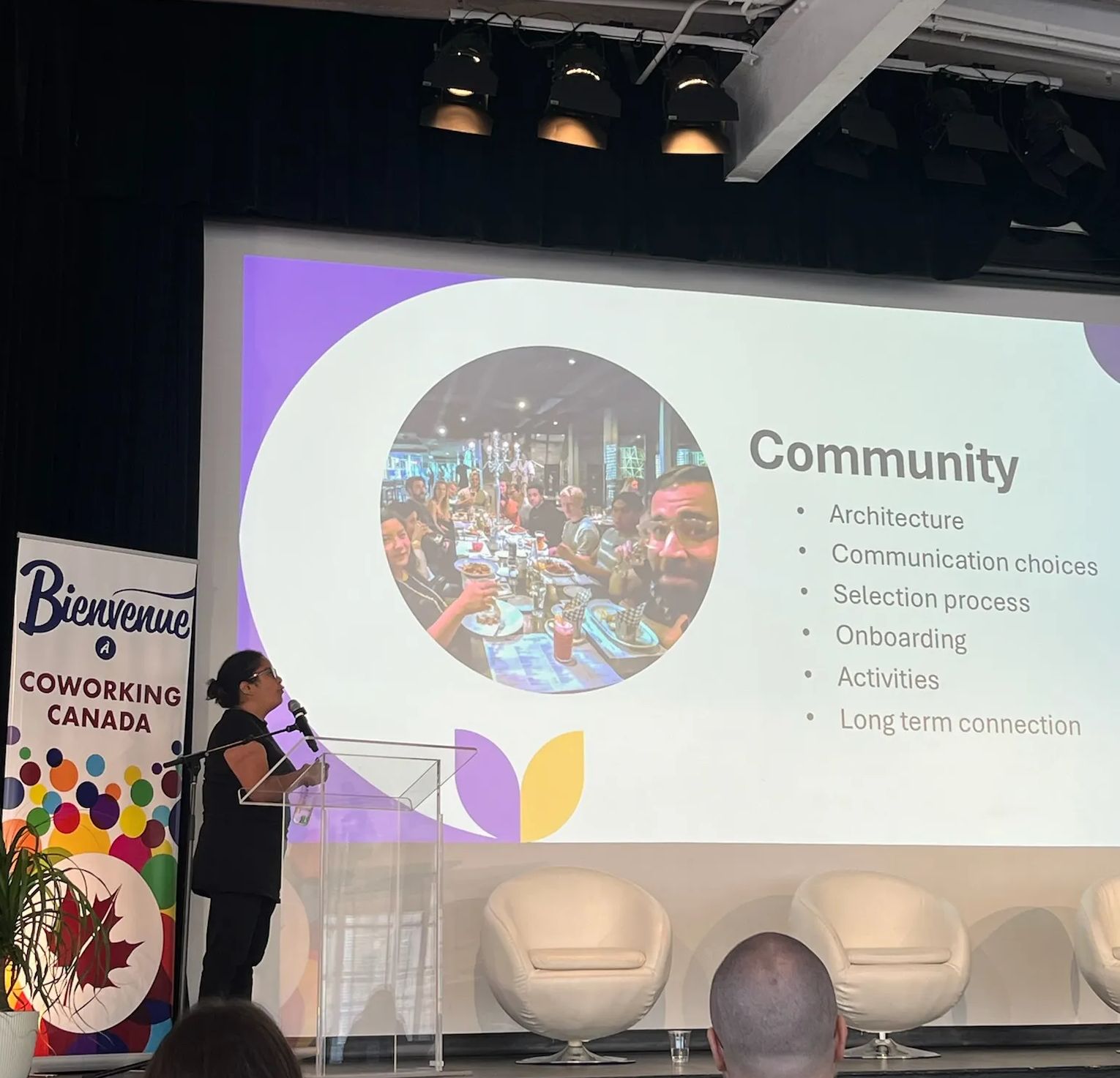
Community does not happen by accident, Maria explained. It is built through architecture, communication choices, selection process, onboarding, activities, and long-term connection. The physical NoCo Board, a chalkboard listing the week’s events like birthday drinks, karaoke, cooking nights, museum visits, and farewell dinners, is as much a part of the infrastructure as the kitchen.
Diversity brings challenges too, she said, and hiring for coliving is harder than hiring for coworking. Her own reason for building Nomad came through in one line: “If I lived alone, I would probably sit at home for dinner and scroll my phone.” The members she hosts came to live differently. That is the product.
Her talk, “Coliving Beyond the Hype,” pulled back the curtain on what it actually takes to run a coliving house. Nomad Coliving is on track to open its third location.
Tawfiq Alla: what the research says about open space and hybrid work
Tawfiq Alla, PhD candidate at UQAM and researcher at TÉLUQ, presented interdisciplinary research on how Québec employees experience open-plan offices when they split their week between home and the workplace.
According to Statistique Canada (2024), 36% of Québec employees telework, and 58% benefit from some form of flexible arrangement (Sondage Concilivi). Inside Tawfiq’s survey of open-plan workers:
The social side is what works. 84% of respondents said their colleagues were welcoming and open. 81% did not feel alone. 56% felt a strong sense of autonomy. This is the part of office life people say they miss when working from home, and it is exactly what a well-run coworking space delivers.
The friction is noise and focus. 43% often or always deal with sound distractions, and 35% struggle to concentrate. Introverts and women reported higher distraction and burnout than their colleagues. If a coworking space feels like an open-plan office, it will carry the same problems.
Tawfiq’s clearest advice for coworking spaces: build more retreat zones (45% of workers often need one), which can be phone booths or a quiet library-style corner within the space. Set clearer noise rules, encourage headphones, seat collaborators together, and treat in-person days as time for connection and remote days as time for deep work.
A detail with direct implications for operators. Employers are increasingly pushing teams back to the office three or four days a week, not two. The pressure is coming from the top. For members choosing where to spend those extra days, the coworking space that solves for both connection and focus is the one that wins.
Greg Lindsay: the city as a social reactor
Greg Lindsay of the University of Toronto School of Cities gave a talk called “Engineering Serendipity,” connecting urban design, remote work, and the role of coworking in all of it.
His core image: A city compresses social networks the same way a fusion reactor compresses matter, producing new ideas, higher GDP, and higher wages. Coworking’s mechanism is the same thing at a smaller scale. In Greg’s words: “Coworking was never about the space. It was always about creating peer networks and how we can actually organize work differently in sharing of ideas.”
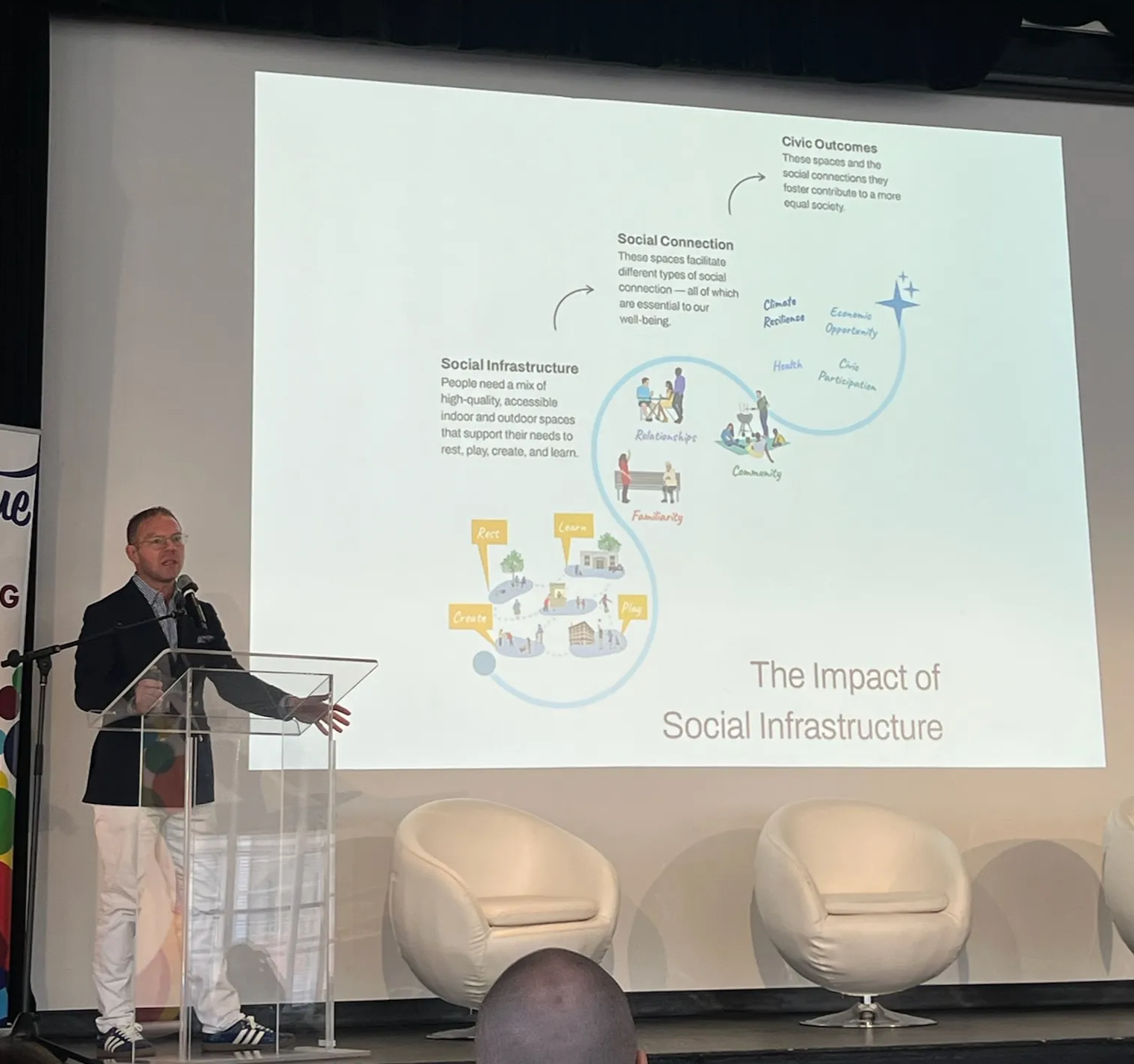
Several forces are pulling that mechanism apart. AI is making it easier to work alone, and large companies are losing their edge over small, agile networks. Remote work and AI together are breaking the ladder for young professionals, with fewer junior hires and less of the in-person mentorship that used to come with them. And fully digital organizations lose what Greg called tacit knowledge, the kind that only moves face to face.
The context outside work is just as relevant. Americans spend over an hour more a day at home than they did in 2003. Face-to-face socializing has fallen across every demographic, with the steepest drops among 15- to 24-year-olds. And the “third places” where strangers used to meet, like bars, bowling alleys, and movie theaters, are closing at a steady rate.
Greg’s line on what that costs you: “If you just go to your office all day and sit up in a tower, you will never meet anyone that you didn’t already know. You will never gain any new forms of novel information, nor will you share it.”
Coworking operators are already filling part of this gap. The role Greg described is the community manager as “mayor” of the neighborhood. Eyes on the street. Stewardship. The person who turns a shared floor into a place where weak ties form, where young professionals find mentors, and where ideas move between people who would otherwise never meet.
Olesy Alekseev: Does your space earn the commute?
Olesy Alekseev of Wellnutcake asked the operators in the room one question: “If a member could work anywhere today, tomorrow, next week, what would make them choose you?”
Her talk framed wellness as a wedge for differentiation. The global wellness real estate market is on track to reach $1.8 trillion by 2030, and wellness is becoming an expectation in everyday workspaces, not a luxury add-on.
Her practical advice:
- Design and programming work together. Aesthetics alone are not enough.
- Build distinct zones for focus, collaboration, and quick mental resets, and manage acoustics so these do not clash.
- Act as a “concierge” by partnering with local gyms, nutritionists, and wellness providers.
- Subsidize regular social moments, like a weekly communal breakfast, to turn a utility into a community.
- Prioritize the invisible metrics: air quality, ventilation, thermal comfort.
- Do member walkthroughs during peak hours to feel the friction yourself.
Her best survey tip: replace “How satisfied are you?” with “What does the space make easier in your workday, and what does it make harder?”
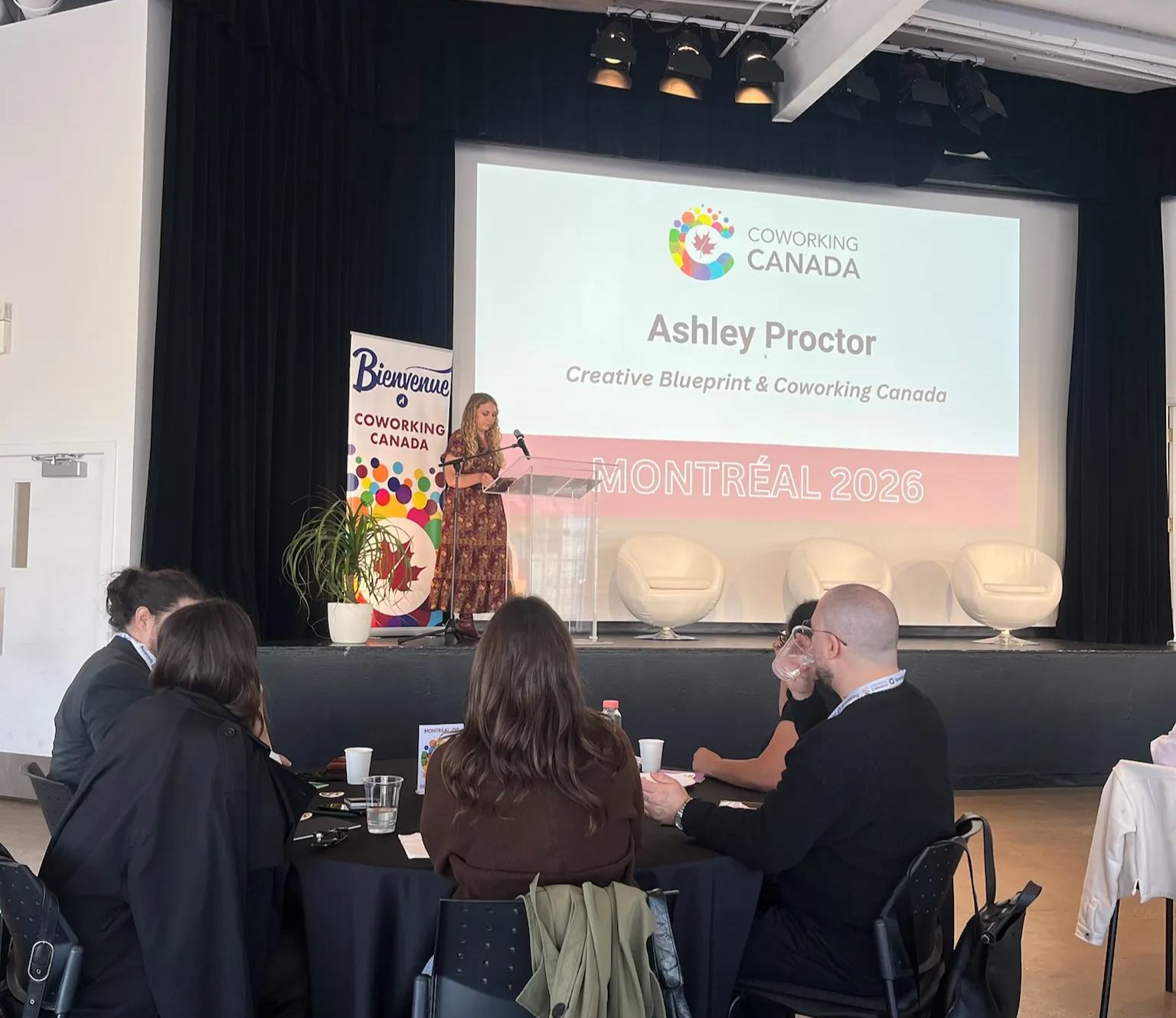
Thank you to Ashley Proctor and the Coworking Canada team for keeping this community going for over a decade. After a few years of catching the Unconference from a distance, being in the room in Montréal, trading notes with operators between sessions and over dinner, was a different kind of learning.
Day two sessions on resilience, scaling, and the practical conversations at Montréal CoWork are coming in part two next week.
If you run a coworking space and want software that handles the operational side so you can focus on the community side, start your free Cobot trial. 30 days, full access to all features, no credit card required.